SpaceND
Campus Space Study Overview
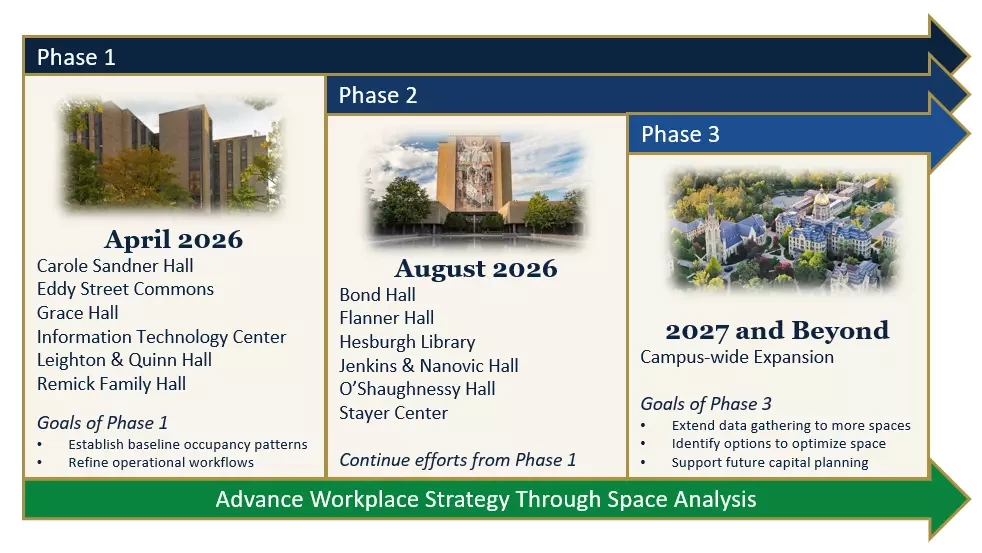
The University of Notre Dame is launching a campus-wide initiative to understand how administrative and academic spaces are currently used and how to improve their effectiveness. Physical space is a finite and valuable institutional resource, and thoughtful stewardship is essential to advancing the University’s mission and strategic goals.
This study focuses on offices, meeting rooms, and shared environments in select campus buildings. Insights from this effort will help Notre Dame identify daily utilization patterns and guide future planning and design.
Purpose of the Study
Notre Dame is conducting this study to:
- Understand how frequently offices and shared environments are occupied
- Identify opportunities to improve the efficiency and effectiveness of space
- Provide data that supports strategic decisions about space planning
- Ensure campus facilities continue to meet evolving institutional needs
How Data Will Be Collected
Walkthrough Observations
Staff employees will conduct brief, scheduled walkthroughs in select buildings to record general occupancy and how shared spaces are being used. Walkthroughs are quick, unobtrusive, and do not involve entering individual offices.
Occupancy Sensing
Sensor‑based technologies will analyze aggregated Wi‑Fi and Bluetooth signal activity to estimate overall occupancy levels within general building zones. For smaller spaces, mmWave sensors will be used to measure occupancy more precisely without capturing any identifiable information. Our measurement technology provider, Occuspace, will be on campus to install sensors and conduct calibration headcounts to ensure accuracy.
Privacy and Data Protection
- Sensors cannot identify individuals or personal devices.
- The sensors are privacy-friendly and do not collect any personally identifiable information.
- The software does not collect any information that can be linked to a specific person.
- Sensors report at the zone or floor level, not inside individual offices.
- All readings convert into aggregated occupancy counts—how many people use a space, not who is present.
- For more information on the sensor-technology approach to privacy, please click here.
How the Data Will Be Used
The collected data will help:
- Identify patterns of occupancy across departments and building zones
- Inform decisions that support more effective use of existing space
- Guide long-term facilities planning and design
- Improve shared environments for work, collaboration, and campus services
The study does not evaluate individual employees or departments. It focuses solely on space use and overall activity patterns.
Contacts
Jaime Sanchez, Director, Capital Program and University Facilities Information, jsanch11@nd.edu
Devin McFarland, Project Manager and Capital Program and Strategy Manager, dmcfarl3@nd.edu